
The Benefits of Automating Cash Operations
Posted on:
October 5, 2026
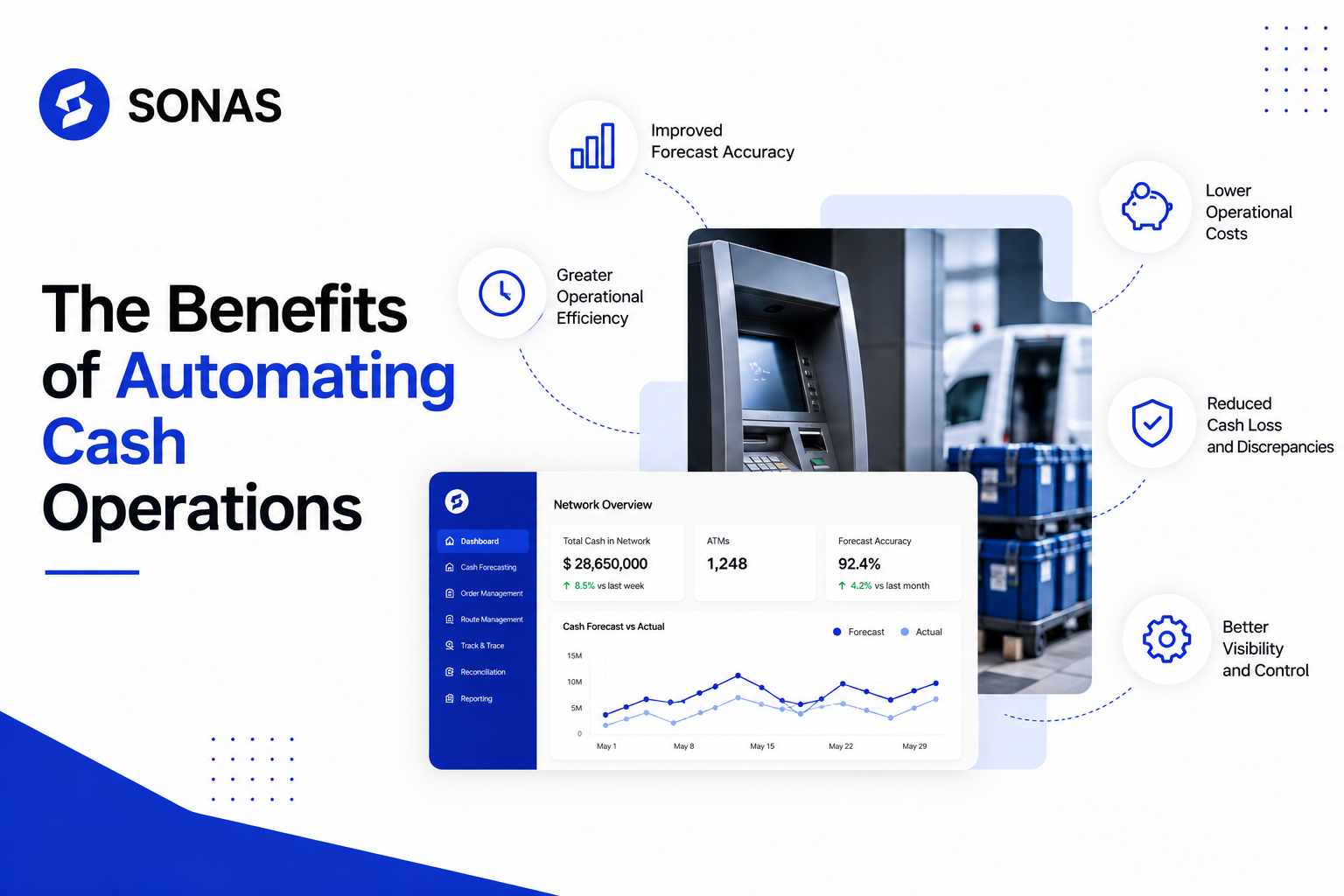
As organisations grow, cash operations tend to grow more complicated with them. More locations, more devices, more cash-in-transit (CIT) collections and more staff involved in counting, reconciling and reporting cash all add up to more manual work — and more room for things to go wrong. What starts as a manageable set of spreadsheets and end-of-day counts can quietly turn into a patchwork of disconnected processes that are slow, error-prone and difficult to oversee.
This is a familiar pattern across retail, hospitality, banking, transport and any business that still handles significant volumes of physical cash. A single site can manage cash reasonably well with a notebook, a safe and a trusted member of staff. But multiply that by ten, fifty or five hundred locations, and the same approach becomes a liability. Every additional site adds another set of counts to reconcile, another CIT schedule to manage, another spreadsheet to maintain and another point at which errors, delays or discrepancies can creep in. Finance and operations teams end up spending disproportionate amounts of time simply trying to answer a basic question: how much cash do we actually have, and where is it?
The costs of this go beyond wasted staff hours. Manual cash processes tie up working capital in excess cash sitting idle in tills and safes, increase exposure to loss and fraud, and make it harder to respond quickly when something goes wrong. They also become an operational bottleneck — every new site or device added to the network increases the administrative load, often at a faster rate than the value that site or device generates.
Cash operations automation addresses this by replacing manual, repetitive tasks with connected, systemised processes — from cash handling and reconciliation to forecasting, ordering, reporting and CIT coordination. Rather than relying on staff to count, record and cross-check cash by hand, automated systems capture data at the point it's generated and make it available in real time, across every location, without manual intervention.
The result is a cash operation that runs more efficiently, with greater accuracy, lower costs and far better visibility. Decisions about replenishment, staffing and CIT scheduling can be based on real data rather than estimates, and problems can be identified and resolved in hours rather than days or weeks.
In this article, we'll look at what cash operations automation actually involves, the problems it solves, the core benefits it delivers, how to start introducing it into your own organisation, and how to measure whether it's working.
What Is Cash Operations Automation?
Cash operations automation is the use of software and connected systems to manage the tasks involved in handling, moving, monitoring and reporting on physical cash — reducing the need for manual counting, spreadsheets and disconnected point solutions.
Depending on the organisation, this can include automating:
• Cash handling — counting, verifying and processing cash through smart safes or cash recyclers rather than manual counting.
• Reconciliation — automatically matching expected and actual cash positions across tills, safes and bank deposits.
• Forecasting — using historical and real-time data to predict cash demand at each location.
• Ordering and replenishment — triggering cash orders based on actual need rather than fixed schedules or guesswork.
• Reporting — generating real-time reports on cash positions, variances and trends without manual compilation.
• Tracking — monitoring cash as it moves between tills, safes, vaults and CIT providers.
• CIT coordination — scheduling and managing collections based on real cash levels rather than routine visits.
In practice, this often relies on connected hardware — smart safes, cash recyclers and note counters — feeding data into a central software platform. That platform is where the real value sits: it's the layer that turns raw cash data from dozens or hundreds of individual devices into a single, usable picture of the entire cash operation.
It's worth distinguishing between automating individual tasks and automating the cash operation as a whole. Many organisations automate one process — reconciliation, for example — while everything around it remains manual and disconnected. A retailer might install smart safes at each site to reduce counting errors, but still forecast cash needs in a spreadsheet and place CIT orders by email. This delivers some benefit, but it also creates a new problem: data sits in isolated systems that don't talk to each other, so no one has a complete view of cash across the business.
The greater benefit comes from connecting these processes together, so that data flows automatically from cash handling through to forecasting, ordering and reporting, giving a single, accurate picture of cash across the business. When handling, reconciliation, forecasting and ordering are connected, a discrepancy identified during reconciliation can automatically flag a review; a forecast can automatically trigger a replenishment order; and a report can be generated instantly, without anyone needing to gather data from separate sources. This is the difference between digitising individual steps and genuinely automating the cash cycle.
The Problem with Manual Cash Processes
Manual cash management tends to create the same set of problems as an organisation scales, regardless of sector. These issues rarely appear all at once — they tend to build gradually, becoming more visible (and more expensive) as the business grows.
• Repetitive administrative work. Counting cash, compiling reports and chasing discrepancies consumes significant staff time that could be spent elsewhere. In many organisations, this work falls to people who could otherwise be focused on customer service, sales or higher-value operational tasks. It's also often duplicated — the same cash may be counted at the till, again at the safe, and again when it's collected by a CIT provider, with each count recorded separately.
• Spreadsheets and disconnected systems. Data is often held in multiple spreadsheets, tills and provider portals that don't talk to each other, making a single view of cash difficult to achieve. Version control becomes a problem in its own right — different sites may use slightly different templates, formulas get overwritten, and consolidating data across locations becomes a manual task in itself.
• Human error and discrepancies. Manual counting and data entry inevitably introduce mistakes, which take further time to identify and correct. A miscounted till, a mistyped figure or a missed entry can trigger hours of investigation to track down a discrepancy that may ultimately turn out to be a simple clerical error.
• Limited visibility. Without real-time data, it's hard to know exactly how much cash is sitting in tills, safes or in transit at any given moment. Decisions about staffing, replenishment or CIT scheduling are often made on outdated information — sometimes days old — rather than the current position.
• Fraud and shrinkage risk. Manual processes with limited oversight make it harder to spot unusual patterns or unauthorised handling of cash. Without clear audit trails or permission controls, it can take weeks to identify where and how a loss occurred, by which point the trail may have gone cold.
• Difficulty scaling. As locations, devices or clients increase, manual processes don't scale proportionately — administrative workload tends to grow even faster than the operation itself. What worked for ten sites becomes unmanageable at fifty, forcing organisations to either add headcount just to keep pace, or accept a growing backlog of unreconciled cash and unresolved discrepancies.
Taken together, these issues don't just cost time and money — they limit an organisation's ability to grow with confidence. Expanding into new locations or taking on new clients becomes harder when every additional site adds a proportional (or greater) amount of manual cash administration.
Key Benefits of Automating Cash Operations
Improved Efficiency
Automation removes much of the manual data entry and administration involved in cash handling. Reconciliation, reporting and cash processing happen faster, workflows become standardised across locations, and staff are freed up to focus on exceptions and higher-value work rather than routine counting and checking.
Rather than someone manually keying data from a till report into a spreadsheet, then cross-referencing that against a bank deposit slip, automated systems capture and match this data as it's generated. Reconciliation that once took hours per site can be reduced to minutes, and end-of-month reporting that required days of manual compilation can be generated on demand. Standardised workflows also mean that every site follows the same process, regardless of who's running it — reducing the reliance on individual staff knowledge or informal workarounds that can vary from location to location.
Perhaps most importantly, automation changes what staff spend their time on. Instead of routine counting and checking, teams can focus on genuine exceptions — a till that's short, a delivery that hasn't arrived, a pattern that looks unusual — which is a far better use of skilled staff time than repetitive administration.
Greater Accuracy
Automated matching and validation reduce the counting, data-entry and reconciliation errors that come with manual processes. Records become more consistent and auditable, giving finance and operations teams greater confidence in the numbers they're working with.
Manual counting is subject to human error regardless of how careful or experienced staff are — miscounts, transposed figures and missed entries are an inevitable part of any manual process carried out at volume. Automated systems remove much of this risk by counting and validating cash electronically, and by matching records automatically rather than relying on someone to spot discrepancies by eye. Over time, this consistency also makes it easier to trust the data being used for forecasting, budgeting and reporting, since it isn't subject to the same variability as manually compiled figures.
Reduced Operational Costs
By cutting down administrative labour, minimising errors and losses, and reducing unnecessary CIT activity, automation makes better use of existing resources. Organisations often find they can manage growing cash volumes without a proportional increase in headcount or cost.
The cost savings from automation tend to come from several directions at once. Administrative labour is reduced as counting, reconciliation and reporting require less manual input. Errors and losses fall as automated validation catches discrepancies earlier, before they compound into larger, harder-to-trace problems. CIT costs also come down, since collections can be scheduled based on actual cash levels rather than fixed routines — avoiding both unnecessary visits to sites that don't need collecting and costly emergency call-outs to sites that have run low unexpectedly. Together, these savings often make automation self-funding within a relatively short period, particularly for organisations managing cash across a large number of sites.
Better Visibility and Control
Automation provides a centralised view of cash across locations, devices, vaults and CIT providers. Real-time cash positions replace end-of-day or end-of-week snapshots, supporting better reporting and faster, more informed decision-making.
For organisations operating across multiple sites, this centralised visibility is often the single biggest shift automation brings. Rather than piecing together a picture of cash from separate reports, spreadsheets and provider updates, finance and operations teams can see exactly how much cash is in each till, safe and vault, and where cash currently sits in transit, at any given moment. This doesn't just make reporting easier — it changes how decisions get made. Replenishment, staffing and CIT scheduling can all be based on the current position rather than a report that may already be out of date by the time it's reviewed.
Improved Cash Forecasting and Utilisation
By using historical and real-time data to predict cash demand, organisations can reduce cash-outs and emergency replenishments, cut down on excess or idle cash sitting unproductively in the network, and optimise replenishment schedules based on actual need.
Manual forecasting is typically based on rough averages or fixed schedules — a site might be replenished every Tuesday and Friday regardless of how much cash it's actually handling that week. This approach tends to lead to two costly outcomes: either sites run short of cash and require expensive, unplanned emergency deliveries, or sites are over-supplied and end up holding excess cash that sits idle rather than being put to productive use. Automated forecasting uses actual transaction and withdrawal data, seasonal patterns and site-specific trends to predict demand far more accurately, allowing replenishment schedules to be adjusted to match real need. This reduces both cash-outs and excess holding, improving overall cash utilisation across the network.
Reduced Risk and Greater Accountability
Digital audit trails and permission controls make it easier to see who did what and when. Discrepancies are identified faster, and investigations or claims are far easier to manage when there's a clear, accurate record to refer back to.
When cash processes are manual, establishing exactly what happened after a discrepancy or loss is discovered can be a lengthy and imprecise process, often relying on memory, handwritten logs or informal notes. Automated systems create a digital record of every transaction, count and adjustment, along with who carried it out and when. This makes it far easier to identify exactly where and when a discrepancy occurred, narrowing an investigation from days to hours. It also supports clearer permission controls, so that only authorised staff can access or adjust cash records, reducing opportunities for error or misuse. When claims do need to be made — with a CIT provider or insurer, for example — having accurate, time-stamped records significantly simplifies the process.
Greater Scalability
Automated cash operations can handle more locations, devices, clients and cash volumes without a corresponding rise in administrative burden. Processes are standardised as the organisation grows, so operations can scale without the workload scaling at the same rate.
This is one of the most significant long-term benefits of automation. In a manual environment, adding a new site typically means adding a proportional amount of administrative work — more counting, more reconciliation, more reporting. With automated processes in place, additional sites, devices or clients can be brought into the same standardised system with comparatively little extra manual effort. This means organisations can grow — whether that's opening new locations, taking on new clients, or expanding cash-handling volumes — without needing to scale administrative headcount at the same rate. For organisations with ambitious growth plans, this is often one of the strongest arguments for automating early, rather than waiting until manual processes become unmanageable.
Manual vs Automated Cash Operations
The differences between manual and automated cash operations are often easiest to see side by side. The table below sets out some of the most common processes affected, and the business benefit that comes from automating each one.
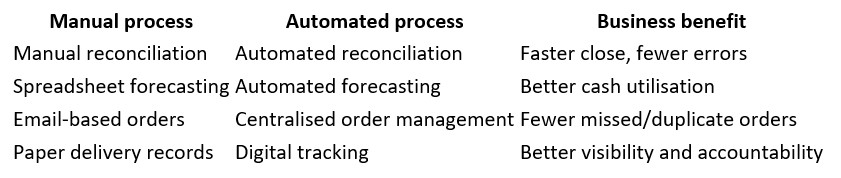
In practice, most organisations don't move from fully manual to fully automated overnight. It's far more common to see a gradual shift — automating reconciliation first, for example, while forecasting and ordering remain manual, before those processes are brought into the same connected system. Even a partial move away from manual processes tends to deliver a noticeable improvement in speed and accuracy, which is often what makes the case for automating further.
How to Start Automating Cash Operations
Automating cash operations doesn't have to happen all at once, and trying to overhaul everything simultaneously is often more disruptive than helpful. A more practical approach is to start small, prove the value, and expand from there.
• Identify the most repetitive or error-prone processes. Start by looking at where staff time is being consumed and where discrepancies most often arise. These are usually the areas where automation will have the most immediate, visible impact — and the easiest to build a business case around.
• Prioritise high-volume activities. Processes that are repeated frequently, or across many sites, tend to offer the greatest return on automating first, simply because the manual effort being removed is greater.
• Start with areas such as reconciliation, forecasting and cash ordering, which tend to offer quick, measurable wins. These processes are often well-suited to automation because they follow clear, repeatable rules, and improvements are easy to demonstrate through reduced time spent and fewer errors.
• Integrate with existing systems rather than replacing everything at once, so automation fits around current infrastructure. Look for solutions that can connect with your existing tills, safes, banking relationships and CIT providers, rather than requiring a wholesale replacement of hardware or processes that are already working well.
• Measure results before expanding. Track the impact of automating an initial process — time saved, errors reduced, costs avoided — before moving on to the next area. This not only builds confidence internally, but also helps identify which processes deliver the greatest value when automated, so subsequent phases can be prioritised accordingly.
This phased approach tends to work better than a single, large-scale rollout, both because it reduces disruption to day-to-day operations and because it gives teams the chance to adapt to new processes gradually, rather than facing wholesale change all at once.
How to Measure the Impact of Automation
To understand whether automation is delivering results, it's important to track meaningful, measurable metrics before and after implementation — not just anecdotal impressions of things "feeling faster." Useful metrics to track include:
• Time spent on manual processes — the hours staff spend counting, reconciling and reporting cash, which should fall noticeably as automation takes on more of this work.
• Reconciliation time — how long it takes to close reconciliation for a given period, which is often one of the fastest and most visible improvements.
• Error and discrepancy rate — the number and value of discrepancies identified, and how this changes as automated matching and validation are introduced.
• Number of spreadsheets in use — a simple but telling indicator of how disconnected cash data still is across the organisation.
• CIT visits and emergency deliveries — the frequency of both routine and unplanned collections, which should decrease as forecasting and replenishment improve.
• Cash utilisation — the proportion of cash actively in use versus sitting idle in tills, safes or vaults.
• Administrative cost — the overall cost of staff time and resources dedicated to cash management.
• Time spent producing reports — how long it takes to compile and generate cash reports, from routine daily summaries through to more detailed management reporting.
Establishing a baseline for these metrics before automating gives you a clear point of comparison, and tracking them consistently afterwards makes it possible to demonstrate — with real figures — exactly what automation has delivered. This is particularly useful when building the case to expand automation into further areas of the cash operation, since it replaces assumptions with evidence.
Choosing the Right Cash Operations Automation Solution
Not all automation tools are created equal, and the right choice depends on the complexity of your cash operation. Rather than working through a generic software checklist, it's worth focusing on the factors that genuinely affect day-to-day cash management:
• Integration capabilities. How well does the solution connect with your existing tills, safes, banking partners and CIT providers? A solution that requires you to replace hardware or renegotiate provider relationships adds cost and disruption that may outweigh the benefits of automating in the first place.
• Scalability. Can it grow with the organisation across new locations and devices, without requiring significant reconfiguration each time a new site is added? This matters particularly for organisations with active expansion plans, where the solution needs to keep pace with growth rather than becoming a bottleneck to it.
• Reporting and analytics. How accessible and detailed is the real-time reporting? Reports should be easy to generate and genuinely useful for day-to-day decision-making, not simply a digital version of a static spreadsheet.
• Security and auditability. Does it support clear permission controls and maintain a complete, tamper-proof audit trail? This is essential not just for day-to-day accountability, but for satisfying internal controls and, where relevant, external audit requirements.
• Workflow automation. Does the solution genuinely remove manual steps, or does it simply digitise them without changing the underlying process? Some tools present data more clearly without actually reducing the manual work involved in getting that data in the first place — it's worth being clear on the difference before committing.
• Ability to connect the cash cycle. Perhaps most importantly, does the solution bring handling, reconciliation, forecasting, ordering and reporting together, rather than automating tasks in isolation? As covered earlier, this is where the greatest long-term value tends to lie, since it gives a single, accurate view of cash rather than a collection of disconnected improvements.
The goal isn't to tick boxes on a feature list — it's to find a solution that genuinely reduces manual work and connects the different parts of your cash operation. The right partner should also understand the practical realities of your sector, whether that's retail, hospitality, banking or another cash-intensive environment, rather than offering a generic solution that hasn't been designed with your specific operational challenges in mind.
FAQs
Is cash operationsautomation only relevant for large organisations?
No. While the benefits scale with volume, even organisations with a handful of locations can reduce errors, save staff time and improve visibility by automating reconciliation and reporting.
Does automating cash operations mean removing staff involvement entirely?
No. Automation removes repetitive administrative tasks, allowing staff to focus on exceptions, investigations and higher-value decision-making rather than replacing the role of people altogether.
How long does it typically take to see results from automation?
This varies by organisation, but many see measurable improvements in reconciliation time and error rates within the first few months, particularly when starting with high-volume processes.
Can automation be introduced gradually, or does it need to be all-or-nothing?
It can, and often should, be introduced gradually — starting with the most repetitive or error-prone processes before expanding to connect the wider cash cycle.
What's the difference between automating individual tasks and automating the whole cash cycle?
Automating individual tasks (like reconciliation alone) delivers isolated improvements, but connecting cash handling, forecasting, ordering and reporting together gives a single, accurate view of cash and greater overall efficiency.
Will automation reduce the number of CIT collections we need?
Often, yes. Better forecasting and real-time visibility mean collections can be scheduled based on actual cash levels rather than fixed routines, reducing unnecessary visits and emergency call-outs.
Conclusion
Cash operations automation delivers clear, measurable benefits: greater efficiency, improved accuracy, reduced operational costs and far better visibility across the entire cash cycle. But its real value goes beyond simply replacing manual tasks with digital ones — it's about creating a cash operation that is more connected, better controlled and able to scale as your organisation grows.
If you're ready to move away from spreadsheets, manual counting and disconnected processes, Sonas can help you build a cash operation that's efficient, accurate and built to scale. Get in touch with our team to find out how.