
What Is Physical Cash Management Software? A Complete Guide to Modern Cash Operations
Posted on:
August 29, 2026
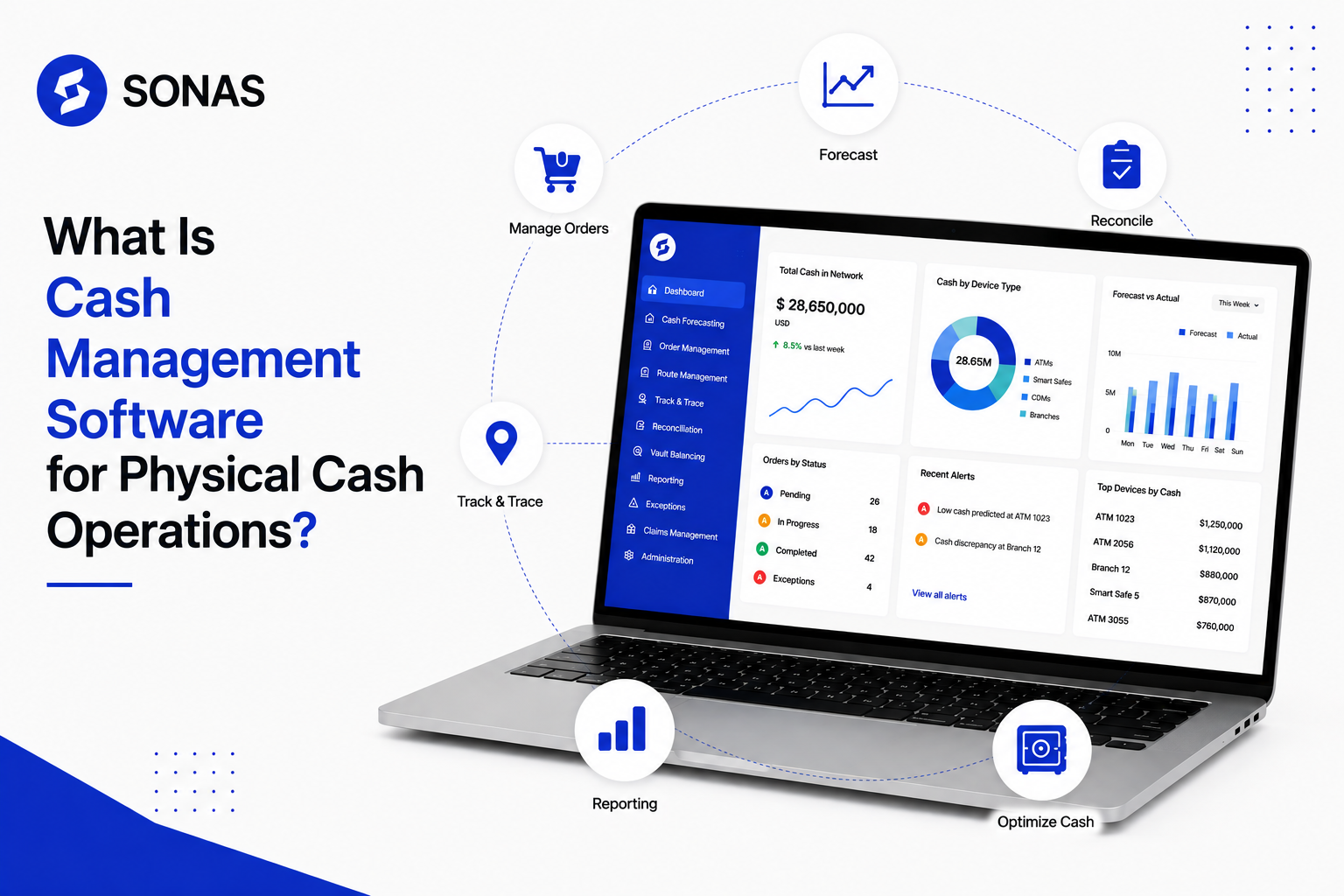
Every day, millions of dollars in physical currency move between bank branches, ATMs, retail businesses, vaults, and Cash-in-Transit (CIT) vehicles. While consumers rarely think about how cash gets where it needs to be, the organisations responsible for managing it face a complex logistical challenge that requires precision, visibility, and strict operational control.
Behind every successful cash movement is a chain of forecasting, order management, vault processing, transportation, reconciliation, and reporting. Yet many organisations still rely on a patchwork of legacy applications, spreadsheets, and manual processes to manage these activities. This creates inefficiencies, which increases operational risk and makes compliance more difficult to manage.
Search for “cash management software”, however, and you'll quickly discover another challenge. Most search results focus on treasury and corporate finance platforms designed to manage digital cash flow, liquidity, and bank accounts. That's an entirely different category of software.
This complete guide explains what physical cash management software is, how it differs from treasury management software, and how modern platforms help organisations improve visibility, automate operations, and manage the entire cash lifecycle.
The Two Meanings of Cash Management Software
Imagine that you are withdrawing $200 from an ATM.
From your perspective, it's a simple transaction that takes just a few minutes, if not seconds. Behind the scenes, however, a carefully coordinated series of events made that withdrawal possible.
Before the cash ever reached the ATM, someone had to forecast demand, generate a replenishment order, prepare the correct denominations in a vault, load them into an armoured vehicle, transport them securely, replenish the ATM, and reconcile every note against multiple transaction records.
That entire operational process is known as physical cash management, and it's supported by software specifically designed to coordinate every stage of the cash lifecycle.
The challenge is that the term "cash management software" is used in two entirely different product categories:
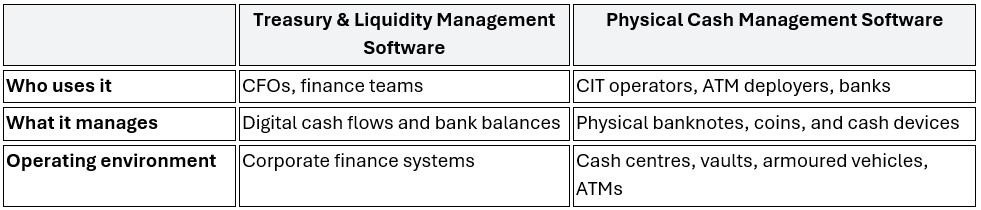
Although both categories use the term cash management, they solve very different business problems.
Treasury and liquidity management platforms help finance teams manage cash positions, banking relationships, and working capital. Physical cash management platforms, on the other hand, are built for organisations responsible for moving, processing, storing, and reconciling physical currency across vaults, ATM networks, bank branches, and Cash-in-Transit operations.
The distinction matters because the operational challenges, users, and software capabilities are fundamentally different, even if the terminology isn't.
What Is Physical Cash Management Software?
Physical cash management software is designed to manage the entire lifecycle of physical currency — from the moment a cash order is created to the point where funds are delivered, reconciled, and reported. Rather than relying on multiple disconnected systems, it brings every stage of the process together in a single platform, giving organisations greater visibility, control, and operational efficiency.
Although every organisation has its own workflows, most physical cash operations follow a similar lifecycle:
Order Creation → Vault Processing → Loading → Transport → Delivery or ATM Replenishment → Reconciliation → Exception Management
As organisations grow, these processes become increasingly difficult to manage manually. What may work for a single vault or a small ATM network often becomes inefficient across multiple locations, customers, and field teams. A unified platform provides the visibility and automation needed to scale operations without adding unnecessary complexity.
A modern cash management platform helps coordinate each of these stages, ensuring information flows seamlessly between departments instead of becoming trapped in separate systems or manual processes.
Whether supporting independent ATM networks[AB2.1], bank branches, retail cash collections, or hospitality environments, the goal is the same: ensure the right amount of cash reaches the right location at the right time while maintaining complete visibility throughout the process. By centralizing operational data, modern platforms help organisations move from reactive, spreadsheet-driven workflows to proactive, data-informed decision-making.
The most effective platforms don't simply replace individual tools. They eliminate the gaps between them. Instead of disconnected software, paper records, and duplicate data entry, every department works from the same real-time information. That creates a single source of truth across the organisation, improving collaboration, reducing manual effort, and helping teams respond more quickly when issues arise.
What Does Physical Cash Management Software Do Day-to-Day?
Although every cash operation is unique, the day-to-day responsibilities are remarkably similar. Teams need to forecast demand, coordinate cash movements, monitor activity in real time, and reconcile transactions accurately, all while maintaining visibility across multiple locations, systems, and stakeholders.
Modern physical cash management software brings these activities together in a single platform. Rather than replacing operational expertise, it gives teams the information and automation they need to make better decisions, respond faster to issues, and reduce manual effort throughout the cash lifecycle.
Most platforms are built around four core operational capabilities:
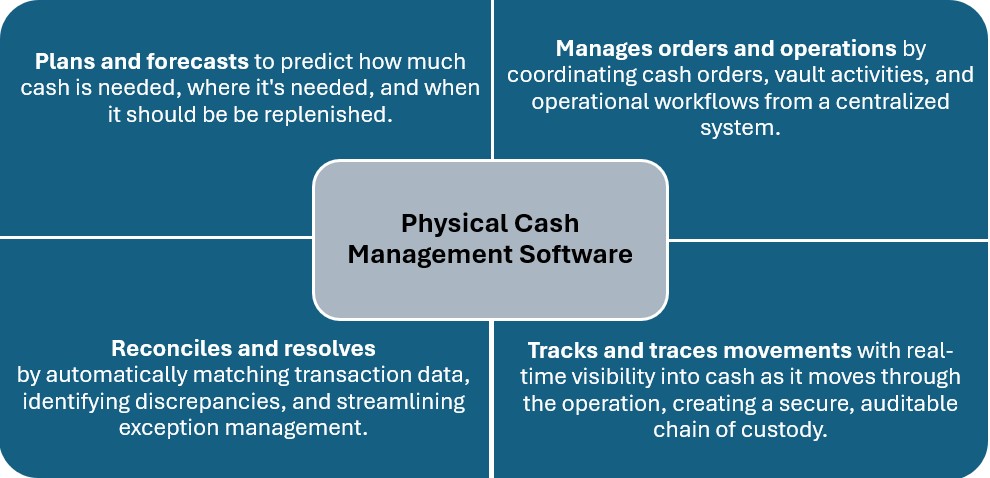
Individually, each of these capabilities delivers operational value. Together, they create something much more powerful: a connected ecosystem where information flows seamlessly between forecasting, order management, transportation, reconciliation, and reporting. Instead of treating each activity as a separate process, organisations gain a unified view of their cash operations, resulting in fewer manual handoffs, faster decision-making, and greater confidence that every team is working from accurate, up-to-date information.
The Problem with Legacy andFragmented Systems
Very few physical cash operations were built around a single, integrated platform. Most evolved over time, adding a spreadsheet here, a legacy application there, and another manual process whenever a new operational challenge emerged.
At first, these workarounds solve immediate problems. But as organisations grow, they often create a fragmented technology environment where information is spread across multiple systems, teams, and processes. The result is reduced visibility, slower decision-making, and greater operational risk.
Although every organisation operates differently, the challenges created by fragmented systems are remarkably consistent.
• Spreadsheet dependency: Spreadsheets may work for individual tasks, but they quickly become difficult to manage across multiple vaults, vehicles, customers, and teams. Manual data entry, version control issues, and limited real-time visibility all increase the likelihood of errors and inefficiencies.
• Siloed data: Operational information is often scattered across separate vault, ATM, banking, and CIT systems. Without a centralized platform, teams spend valuable time switching between applications and manually piecing together a complete picture of daily operations.
• Manual reconciliation: Reconciling transactions across multiple systems can consume hours, or even days, of valuable staff time. The more manual the process, the greater the risk of delays, discrepancies, and overlooked exceptions.
• Limited operational visibility: Without real-time information, managers often discover problems only after they've affected customers, operations, or service levels. Whether it's an ATM running low on cash or an unexpected delay in the field, reactive decision-making is rarely the most efficient option.
• Slow exception resolution: When discrepancies are managed through email chains, spreadsheets, and paper records, investigations become slower and more difficult to track. The longer issues remain unresolved, the greater the operational and financial impact.
• Compliance and audit risk: Incomplete audit trails and inconsistent documentation make it more difficult to demonstrate compliance during regulatory reviews, customer audits, or insurance investigations.
For many organisations, these challenges develop gradually rather than all at once. As operations expand, manual processes become increasingly difficult to sustain, prompting many organisations to evaluate whether a unified cash management platform can improve visibility, efficiency, and control.
How Modern Cash Management Platforms Improve Physical Cash Operations
Running an efficient physical cash operation requires far more than moving currency from one location to another. Organisations must accurately forecast demand, coordinate orders, process and transport cash securely, reconcile every transaction, resolve exceptions quickly, and provide managers with the visibility needed to continuously improve performance.
Trying to manage these activities across disconnected systems and manual processes often leads to unnecessary costs, operational delays, and limited visibility. Modern cash management platforms bring these functions together within a single operational environment, allowing information to flow seamlessly across every stage of the cash lifecycle.
Rather than serving as standalone software features, the following capabilities work together to help organisations improve efficiency, strengthen accountability, reduce operational risk, and make better business decisions.
Cash Forecasting
One of the biggest challenges in physical cash operations is balancing cash availability with operational efficiency. Too little cash increases the risk of ATM cash-outs and service disruptions. Too much cash ties up working capital and often results in unnecessary replenishment costs.
Modern cash forecasting tools analyse historical transaction data, seasonal demand, pay cycles, holidays, and local events to predict when and where cash will be needed. Those forecasts can automatically generate replenishment recommendations and integrate with downstream operational workflows, helping organisations keep cash available while reducing unnecessary transportation and inventory costs.
The result is improved service levels, fewer emergency replenishments, better utilisation of working capital, and a more efficient cash operation.
Order Management
Accurate forecasts only create value if cash orders can be executed efficiently. Coordinating ATM replenishments, branch deliveries, retail collections, and vault activities requires every team to work from the same operational plan.
A centralized order management capability creates, tracks, and manages every cash order from a single platform. Orders can be generated manually or automatically based on forecasted demand, service schedules, or real-time inventory levels, while dashboards provide operations teams and authorized customers with visibility into order status throughout the fulfilment process.
By replacing disconnected workflows with a centralized system, organisations reduce communication gaps, improve coordination between departments, and deliver a more consistent level of service.
Cash Centre Operations — Vault Balancing and Cash Processing
Cash centres sit at the heart of every physical cash operation. Maintaining accurate inventory, processing large volumes of currency, and ensuring every movement is fully documented requires precise operational controls and complete visibility.
Modern cash management platforms provide real-time visibility into vault inventory by denomination, customer, and location while recording every movement from intake through processing and dispatch. Digital verification, automated balancing, and comprehensive audit trails help improve accuracy while reducing reliance on manual recordkeeping.
This enables stronger inventory control, greater operational accountability, and increased confidence that cash is exactly where it should be throughout the processing lifecycle.
Track & Trace
Once cash leaves the vault, maintaining visibility becomes significantly more challenging. Organisations need confidence that every shipment is documented, every stop is verified, and every asset can be accounted for throughout its journey.
Track and Trace capabilities provide real-time visibility into cash movements, vehicle locations, custody transfers, and delivery confirmations. GPS integration, barcode scanning, mobile applications, and digital proof of delivery help create a complete chain of custody from dispatch through final delivery.
The result is greater transparency, improved customer service, faster issue resolution, and stronger security across the transportation process.
Cash Reconciliation
Reconciliation is often one of the most time-consuming and resource-intensive activities in physical cash operations. Transaction data frequently arrives from multiple banks, ATM networks, customers, and operational systems, making manual matching both slow and prone to error.
Modern cash reconciliation capabilities automatically compare transactions, balances, and settlement records across multiple data sources while quickly identifying discrepancies that require investigation. Automated workflows dramatically reduce manual effort while improving financial accuracy.
Organisations benefit from faster reconciliation cycles, reduced administrative workload, and greater confidence in the accuracy of their financial reporting.
Case Management
No cash operation is immune to discrepancies. Delivery exceptions, reconciliation differences, customer inquiries, and operational incidents are inevitable. The real differentiator is how quickly those issues can be investigated and resolved.
Integrated case management provides a centralized workspace where teams can document issues, assign ownership, track investigations, and maintain a complete history of actions taken. Supporting documents, communications, and audit information remain connected to each case, eliminating the need to search across multiple systems.
This shortens resolution times, improves accountability, and creates a more consistent process for managing operational exceptions.
Reporting and Analytics
Operational data has little value unless it helps managers make better decisions. Without timely visibility into performance, organisations often identify trends only after they have already affected customer service, costs, or operational efficiency.
Modern reporting and analytics transform operational data into meaningful business intelligence through configurable dashboards, performance metrics, KPI tracking, and exception reporting. Decision-makers gain real-time insight into cash positions, operational performance, service levels, reconciliation status, and emerging trends.
Rather than simply reporting on what happened, these insights help organisations identify improvement opportunities, optimise resources, reduce costs, and support continuous operational improvement.
________________________________________
While each of these operational capabilities delivers value on their own, their true strength comes from working together as a connected platform. By integrating every stage of the physical cash lifecycle—from forecasting and order management to reconciliation and analytics—organisations gain greater visibility, stronger operational control, and the insights needed to improve efficiency, reduce risk, and make better business decisions.
Who Uses Physical Cash Management Software?
While physical cash management software supports organisations across the entire cash ecosystem – from global Cash-in-Transit providers to banks, Independent ATM Deployers, and organisations that manage their own cash operations – each operates differently. However, they share a common need for greater visibility, operational control, and accurate reconciliation.
Cash-in-Transit Companies
CIT companies are the primary users of end-to-end cash management platforms. They manage multi-client vault operations, armoured transport, route planning, and reconciliation at scale — often as the outsourced partner for banks, retailers, and ATM deployers. The platform needs to support multi-client visibility, client portal access, and reconciliation across multiple data sources simultaneously.
Independent ATM Deployers
Independent ATM Deployers (IADs) own and operate ATM networks outside of financial institutions. They use physical cash management software primarily to optimise replenishment schedules, prevent cash-outs, and reconcile their ATM networks. Because IADs often fund and handle cash logistics themselves, forecasting accuracy and route efficiency are especially high priorities. Some IADs outsource CIT to a third party; the right platform accommodates both models.
Banks and Financial Institutions
Banks manage ATM estates, branch cash supply, and compliance-grade reconciliation. Some operate their own internal CIT teams; others outsource logistics to a CIT provider and use the software to oversee and coordinate that relationship. Key requirements include ATM cash position visibility, client-side order management, and reconciliation that meets regulatory standards
Other Operators
Beyond these core user groups, physical cash management software also serves:
• Retail and hospitality environments with significant cash handling needs
• Crypto ATM operators monitoring kiosk cash levels and automating reconciliation across distributed networks
• Payment processors matching settlement files and managing disputes across partner networks
The best platforms are flexible enough to support fully in-house operations — where an organisation manages its own cash, vehicles, and staff — as well as fully outsourced models where a CIT partner handles all physical logistics.
Why a Unified Platform Delivers Greater Value
As physical cash operations grow, the challenge isn't simply managing more cash—it's managing more complexity. Forecasting, vault operations, transportation, reconciliation, reporting, and customer communication all generate valuable operational data. When that information is spread across multiple systems, spreadsheets, and manual processes, teams spend more time searching for information than acting on it.
A unified cash management platform eliminates those silos by creating a single operational environment where information flows seamlessly across every stage of the cash lifecycle. Instead of isolated software modules, organisations gain connected workflows that improve visibility, strengthen operational control, and enable better decision-making.
The result is a platform that delivers greater value than the sum of its individual capabilities:
________________________________________
Greater Operational Efficiency
Manual handoffs between disconnected systems slow operations and increase the risk of errors. A unified platform automates workflows across forecasting, order creation, route planning, reconciliation, and exception management, reducing repetitive administrative work while allowing teams to focus on higher-value activities.
________________________________________
Real-Time Operational Visibility
Decision-makers need immediate access to accurate information. By bringing vault activity, vehicle movements, ATM status, customer orders, and reconciliation data into one platform, managers gain a live view of operations that supports faster, more informed decisions.
________________________________________
Stronger Compliance and Accountability
Every cash movement should be traceable from beginning to end. Digital audit trails, timestamped transactions, and role-based access controls strengthen governance while simplifying regulatory reporting, customer audits, and internal investigations.
________________________________________
Lower Operating Costs
Better visibility leads directly to better operational decisions. Improved forecasting reduces unnecessary cash holdings, optimised replenishment schedules minimize transportation costs, and automated reconciliation decreases manual labor — all contributing to measurable cost savings.
________________________________________
Scalable Growth
As organisations expand, disconnected systems often require additional staff and increasingly complex processes to keep pace. A unified platform allows operations to grow without proportionally increasing administrative overhead, making it easier to add customers, locations, or services while maintaining consistent operational performance.
________________________________________
The greatest advantage of a unified cash management platform isn't simply automation—it's operational alignment. When forecasting, logistics, reconciliation, reporting, and analytics work together within a single environment, organisations gain the visibility, efficiency, and control needed to continuously improve performance while supporting future growth.
Leading platforms, such as Sonas, put these principles into practice by helping organisations streamline reconciliation, improve vault balance accuracy, and resolve disputes more efficiently. This delivers measurable operational improvements that directly impact the bottom line.
Choosing the Right Physical Cash Management Platform
Selecting a physical cash management platform is more than a software decision—it's an operational investment that can shape efficiency, visibility, and scalability for years to come. While many vendors offer similar features on paper, the real difference lies in how effectively a platform supports the entire cash lifecycle, integrates with existing systems, and adapts as operational requirements evolve.
While feature lists are important, they tell only part of the story. You should evaluate each solution by asking the questions that have the greatest impact on long-term operational success.
________________________________________
Does the platform support the entire cash lifecycle?
Some solutions address only a single function, such as forecasting, route planning, or reconciliation. Others provide an integrated platform that connects every stage of the cash lifecycle — from forecasting and order management to vault operations, transportation, reconciliation, reporting, and analytics.
End-to-end platforms eliminate data silos, automate cross-functional workflows, and provide a single source of truth across the entire operation.
________________________________________
Can you implement the platform at your own pace?
Operational needs change over time. A flexible platform should allow organisations to begin with the capabilities they need today while expanding into additional modules as requirements grow.
This modular approach reduces implementation risk, shortens deployment timelines, and protects long-term technology investments.
________________________________________
Is the platform built for the cloud?
Cloud-native platforms provide secure, real-time access from any location without the infrastructure costs and maintenance requirements associated with on-premise systems.
For organisations operating multiple vaults, branches, or field teams, cloud infrastructure enables faster deployments, simplified updates, and consistent access to operational data across the business.
________________________________________
Will it integrate with your existing technology?
No cash management platform operates in isolation. The best solutions integrate seamlessly with ATM monitoring systems, banking platforms, ERP applications, data feeds, and third-party Cash-in-Transit systems through modern APIs.
Strong integrations reduce manual data entry, improve data accuracy, and accelerate operational processes such as reconciliation and reporting.
________________________________________
Does it support your field workforce?
Field operations are a critical part of the cash lifecycle. Mobile functionality should enable drivers and field operatives to receive assignments, capture digital proof of service, scan assets, collect signatures, document exceptions, and submit information in real time.
Replacing paper-based processes with mobile workflows improves operational accuracy while giving management immediate visibility into field activity.
________________________________________
Can customers and partners securely access the information they need?
For Cash-in-Transit providers and organisations managing outsourced operations, transparency is essential. Multi-client portals and role-based access allow customers, banking partners, and other stakeholders to securely access relevant operational information without compromising security.
Providing timely, self-service visibility strengthens customer relationships while reducing administrative requests.
________________________________________
Will the platform scale with your business?
As operations grow, technology should enable expansion rather than create additional complexity. A scalable platform should support increasing transaction volumes, new locations, larger ATM networks, and additional customers without requiring major system changes or significant increases in administrative overhead.
The right solution should continue delivering value as your organisation evolves.
________________________________________
Does the vendor understand physical cash operations?
Technology is only one part of a successful implementation. Look for a provider with deep operational expertise in physical cash management, including experience working with banks, Cash-in-Transit providers, and Independent ATM Deployers.
Industry knowledge can make a significant difference during implementation, training, process optimisation, and ongoing support.
________________________________________
Balance Features withOperational Outcomes
Key features are an important part of any software evaluation, but they tell only part of the story. The most successful implementations come from selecting a platform that not only provides the capabilities you need today, but also improves operational efficiency, strengthens compliance, supports future growth, and delivers measurable business outcomes over time.
By evaluating solutions through the lens of both functionality and operational outcomes, organisations are better positioned to choose a platform that delivers lasting value—not just another software implementation.
From Fragmented to Connected: The Benefits of a Unified Physical Cash Management Platform
Managing physical cash has become increasingly complex. Organisations must balance operational efficiency, regulatory compliance, customer expectations, and cost control while coordinating every stage of the cash lifecycle. Meeting those demands requires more than disconnected systems and manual processes—it requires a connected approach to managing physical cash.
A unified physical cash management platform brings forecasting, order management, vault operations, transportation, reconciliation, reporting, and analytics together within a single operational environment. The result is greater visibility, stronger operational control, improved compliance, and the insights needed to make faster, better-informed decisions.
Organisations that move from fragmented systems to connected operations are better positioned to reduce costs, strengthen customer service, improve accountability, and scale confidently as their business evolves. As operational complexity continues to grow, investing in a unified platform is no longer simply a technology decision — it's a strategic investment in the future performance of your operation.
Ready to see what a unified physical cash management platform looks like in practice? Explore Sonas and schedule a demo to discover how connected operations can help transform your physical cash management processes.
Frequently Asked Questions
1. What does physical cashmanagement software do?
Physical cash management software helps organisations manage the movement, processing, tracking, and reconciliation of physical currency across the entire cash lifecycle. It connects forecasting, cash ordering, vault operations, transportation, reconciliation, reporting, and analytics within a single platform, improving operational visibility, efficiency, and compliance.
2. What should you look forin a physical cash management platform?
When evaluating physical cash management software, organisations should look beyond individual features and consider how well a platform supports the complete cash lifecycle. Key considerations include end-to-end operational coverage, cloud deployment, system integrations, mobile workforce support, scalability, security, and industry expertise. The best platforms combine robust functionality with measurable operational outcomes.
3. Who fills cash in ATMs?
Physical cash management software helps coordinate the entire replenishment process — from forecasting cash demand and generating replenishment orders to tracking deliveries, reconciling cash movements, and providing complete operational visibility.
4. Who manages physical cash operations?
Physical cash operations are managed by different organisations depending on the operating model. Cash-in-Transit (CIT) companies transport and process currency, banks oversee ATM and branch cash operations, and Independent ATM Deployers (IADs) manage their own ATM estates. Many organisations outsource some or all of these activities to specialist CIT providers. Modern physical cash management software supports both in-house and outsourced operating models.
5. What fees are involved in physical cash management?
Costs vary depending on the operating model but typically include Cash-in-Transit transportation fees, vault processing charges, ATM maintenance, cash handling costs, and software licensing. While software is an investment, modern physical cash management platforms often reduce total operating costs by improving forecasting accuracy, optimising replenishment schedules, reducing unnecessary CIT visits, minimizing cash losses, and streamlining reconciliation.
6. Is the data in cash management software secure?
Modern enterprise platforms are built with security at their core, including role-based permissions, encrypted data transmission, comprehensive audit logging, and secure cloud infrastructure. Every cash movement and user action is recorded, creating a complete chain of custody that supports compliance, investigations, and insurance requirements.
7. What is the difference between cash management software and treasury management software?
Treasury management software handles digital cash flows, bank account balances, and corporate liquidity for finance teams — it deals in ledger entries, not banknotes. Physical cash management software manages the real-world movement, processing, tracking, and reconciliation of banknotes and coins across CIT operations, ATM networks, vaults, and field teams. Although the names sound similar, treasury management software and physical cash management software solve fundamentally different business problems.
8. Can physical cash management software support both outsourced and in-house operations?
Yes. The best platforms are designed to support fully in-house operations — where an organisation manages its own cash, vehicles, and staff — as well as outsourced models where a CIT provider handles physical logistics on behalf of a bank or ATM operator. Multi-client visibility and client portal access are key features for outsourced models. Many organisations also transition between these operating models over time, making platform flexibility an important consideration when selecting a long-term solution.